

made for experts not nubes
The demand for SOTA sequencing tech (spatial and single-cell) is outpacing the number of expert experimentalists and bioinformaticians.
Most companies that aim to facilitate data analysis for biologists have opted to address the biologists that don’t code as well as the simplest workflows (bulk genome and transcriptome analysis via Latch, Form, Watershed, etc). However, relatively few tools have been built for the most complex use-cases such as single-cell and spatial transcriptomics. Software that has been built here (CellxGene) are in the purview of non-profit sector which is great for the broader community and an indication that there might be a proverbial gap in the market.
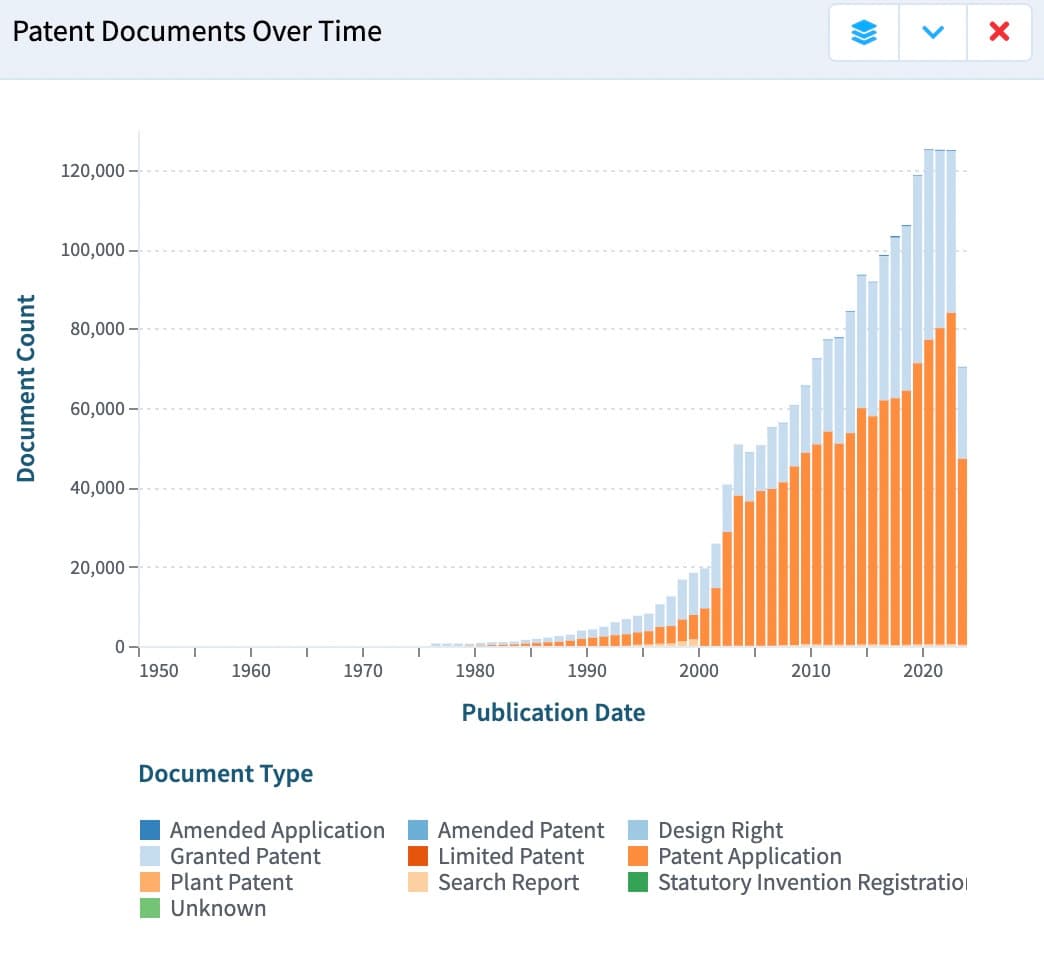
Patents for single-cell transcriptomics-related technologies over time from lens.org.
The relative dearth of software here is primarily because of the small market size. However, the demand for of single-cell and spatial -omics might outstrip the number of ‘expert labs’ and require expanded feature sets not currently included in the incumbent tools. Because of this, there’s potential opportunity for a company to be built in the SOTA data capture and analysis market. Ideally, a company would start capturing the expert market as they try to scale experiments and analyses to identify rare cell types, cell-cell interactions, cellular lineages, and heterogeneity. There would then be natural selection for new customers to use the expert-verified platform which has advanced feature sets already in-built. In order to capture value in the presently small market, a company would ideally have wet lab capabilities which it could use to carry out the experiments. The wet lab would have the most up-to-date life science tools such as the MERSCOPE platform for combined single-cell and spatial genomics. In addition to this great UI/UX and facile data probing to get to the actionable insights would create a combined data generation and product moat. As single-cell metabolomics and proteomics, and epigenomics proliferate an ideal companies would be able to layer in these added functionalities. The downside of this model is that it would trade on somewhat of a discount given the services model but eventually could transition to purely a software company as more analysis of SOTA methods becomes commonplace.