


With this piece, we strive to ask the biggest questions in biotech today. This is mainly due to incredibly divergent world views and world building we hear in biotech every day such as: “The Food and Drug Administration (FDA) is dead in 10 years”, “No one can beat Eli Lilly”, “Anthropic will make drugs and become a pharma co”, “HIMS will become the frontend distribution for biotech”, “Frontier labs will not expand CRO TAM”, “China has won biotech”, and others.
Each of these statements is implicitly destructive or entrenching for the biotech/pharma industry today. The Russian doll of layered questions and path dependencies is something that should be explored concretely to make the assumptions, undercurrents, and wagers, explicit.
To fully understand where we are, and what this means for company building opportunities, we created a decision tree of the most consequential boom or bust forks in the road over the next 10 years of biotech. As Ada Palmer astutely pinpoints on a recent Dwarkesh podcast, history normally doesn’t ask the right questions, due to focus on small vs. global changes. We try to not fall into that by asking the largest questions possible. Specifically, we make arguments on either side of:
Neolabs in bio will become very large, independent companies
Next-gen contract research organizations (CROs) that generate data for frontier and neolabs (along with biotechs) will become very big businesses
China will become the global hub of biotech
There will be more drug approvals per year in the US
There will be a collapse of incumbent drug distribution.
Biopharma becomes hyper-deflationary in mid-term (many assets for every target) and returns diminish drastically due to competitive pricing and higher distribution/marketing costs.
The asset-centric turn in biotech VC produce a wave of orphaned, single-asset companies.
We strive to have clear, defined bear and bull cases to help builders more accurately underwrite their company’s trajectory and implicit assumptions of it.

Fork #1: Neolabs in bio will become very large, independent companies.
Context: What we still don’t know is what a bio neolab that finds PMF with scientists, biotech, the world, looks like. What we do know is that forming the best bioML teams works for mid-size acquisitions (EvoscaleAI acquired by Chan-Zuckerberg Initiative and Coefficient Bio acquired by Anthropic) OR mid 8-figure deals with pharma (Chai Discovery and Eli Lilly and NOETIK and GSK). An inherent assumption in founders and VCs continuing to back these neolabs is that they will, with a technical step change, unlock new biological understanding and crucially be able to pair that with highly valuable product market fit (PMF). Yes or no?
Yes - Step changes in biological understanding through bio-AI labs will be meaningfully more valuable to pharma, biotech, and society than they were historically. Companies with the best ML teams which will prove themselves first in open benchmarks, increased predictive power, predicting disease progression, understanding toxicity, will be able to productize quickly after the science unlock to their ideal customers and broader industry once the technological unlock happens. Not only does there have to be excellent technology and compounding scientific speed/moats but continued model development, proprietary data acquisition, and productization will be required of the team.
No - the best ML-bio teams are acquihired by the frontier labs or neolabs further along. Expect to see Meta-level comp packages to thwart competition and upstarts before they even begin. Another version of neolabs not being successful is if initial benchmark steps can’t be compounded scientifically or quickly productized to key customers to justify their valuations and burn by the companies. Neolabs experience a valley of death transitioning from a technology-first company to a product-first company. Some of the complexity is the relative market size of biopharma vs. general LLMs and build vs. buy dynamics which biopharma is rife with.
Fork #2*: Next-gen contract research organizations (CROs) will become very big businesses.
Context: CROs today are massive businesses. Lonza makes $8bn+ per year, WuXi $6bn+, Charles River makes $4bn+. These companies have been dominant in CROs for decades and have relationships and incumbency dynamics with biotech and pharma companies which have made it hard for upstarts to unseat. With new potential customers in frontier and neolabs, patients vibecoding, and those using LLMs to do experiments as hobbies, there could be room for next-generation CROs that service net new customers. The question is whether next-generation CROs could become really large, durable businesses, given structural disadvantages. Yes or no?
Yes - Next-generation CROs will better serve the new range of customers of patients, biotech hobbyists, neolabs and frontier labs. Next-generation CROs will use state-of-the-art hardware, automate every possible step of the process and work quickly to ship to customers. On one end, self-serve experiments for small orders by patients and hobbyists with no relationships with incumbents could be possible. Next-generation CROs would likely have better UI/UX and could serve these customers from the earliest days of the CRO. On the other end, serving frontier labs and neolabs has similar opportunities of building relationships with customer new to biotech. CROs that generate libraries of training data for frontier labs and for bio neolabs becoming defensible versions of Mercor and ScaleAI for bio. Think of this as Plasmidsaurus to Genewiz, but for WuXi AppTec.) If you believe that all pharma companies become AI companies, this is another tailwind for next-generation CROs, but isn’t required for them to be successful.
No - Frontier labs and bio neolabs will not pay for scaled, unique biological data and will stick to model development vs. buying proprietary data. Another version of this is that neolabs are acquihired by Frontier labs too early which concentrates customers to the point where there isn’t a thriving, cash-rich industry for next-generation CROs to sell directly into over long periods of time. This would require early pivots to biopharma before there’s a large cost and data scale differential in data generation. It will be hard to sell over Lonza, WuXi, and Charles River since incumbents have relationships and rapport with all of these folks.
**Fork #2 is Russian doll-nested inside the question of whether frontier labs (OpenAI and Anthropic) will move materially into bioAI and if neolabs become large, separate entities with 9-10 figure data spend ability.
Fork #3: China will become the global hub of biotech.
Context: The US is scared of losing global dominance in every domain. In biotech’s specific insecurity, there’s a big discussion on whether China surpassing us in clinical trials and innovation generally would lead to a collapse of the US biotech ecosystem. There’s a deeper point on whether geopolitical tensions could lead to supply chain fragility for active pharmaceutical ingredients (API), talent arbitrage forcing companies to use off-shore resources, all under the backdrop of IP theft. The Erasca and Revolution Medicines patent infringement debacle shows that there’s clear infringement for seemingly every molecule that’s made in China. The question is will China become the dominant biotech player or not?
Yes - China’s dominance on drug research and development, clinical trials, and manufacturing will only compound in the upcoming years. Their economies of scale, labor cost arbitrage, AI and robots excellence interface with scaled human studies and scaled manufacturing seamlessly. The best talent in the West increasingly studies at Chinese universities, fights for jobs to Chinese biotech companies and tenure positions, with China becoming an international magnet.
No - China’s aggressive action in the South Pacific and annexation of Taiwan reduces connectivity of China with the rest of the world, making it harder to do business there. Second to that, China has shown the rest of the world what is needed for a productive and scalable biotech industry (fast human evidence, fast innovation and manufacturing cycles, cheaper cost of goods sold (COGS)). The rest of the world aggressively copies the fast human experimentation laws, automation of bio R&D and innovation removes the relative cost savings of China vs. the West. In the intermediate term, China is used for fast human evidence but limited R&D happens there by international companies given likely risks of IP infringement.
Fork #4: There will be more drug approvals per year in the US
Context: Money is scarce to actually do clinical trials in the US (Series A+ biotech venture rounds have decreased since all-time-highs in 2021) and drug approval rates have plateaued over time. At the same time, people are now just making their own treatment pathways to cure “terminal” cancer (and their dogs’!). Adding to the backdrop is that we have more molecules to screen than ever with an ever-increasing docket of modalities and ML models broadening the search space of new compounds and libraries. Compound these increased therapeutic options, national biobank efforts have increased the amount of longitudinal, multiomic information significantly (at least 2M paired whole-genome sequence and medical records). The question is do these tailwinds translate to more drug approvals per year?
Yes - In a world with magnitudes of broadly accessible data, more tools to make drugs, better perspectives on screens, and where people are making their own drugs (Sid and Rosie), it’s inevitable that we will break out of the 50 drug approvals per year plateau. Competition from China enforces more capital efficiency in US biotech where companies pursue the path to human evidence aggressively and cost effectively. There’s a rise in Phase 0 which multiplexes lead series of compounds and biologics which improves adsorption, distribution, metabolism, excretion, and toxicity (ADMET) properties significantly while checking for strong target engagement. If the US doesn’t immediately change its regulatory processes, biotechs will do their clinical trials abroad to get efficacy readouts more cost effectively. A rise in human challenge trials for human steady state pushes the boundaries of human health to human enhancement. This means that incremental dollars spent could have higher output both on failing quickly and having more in vivo iterations. Increased amounts of drugs approved per year would likely spur more biotech investment leading to a compounding output.
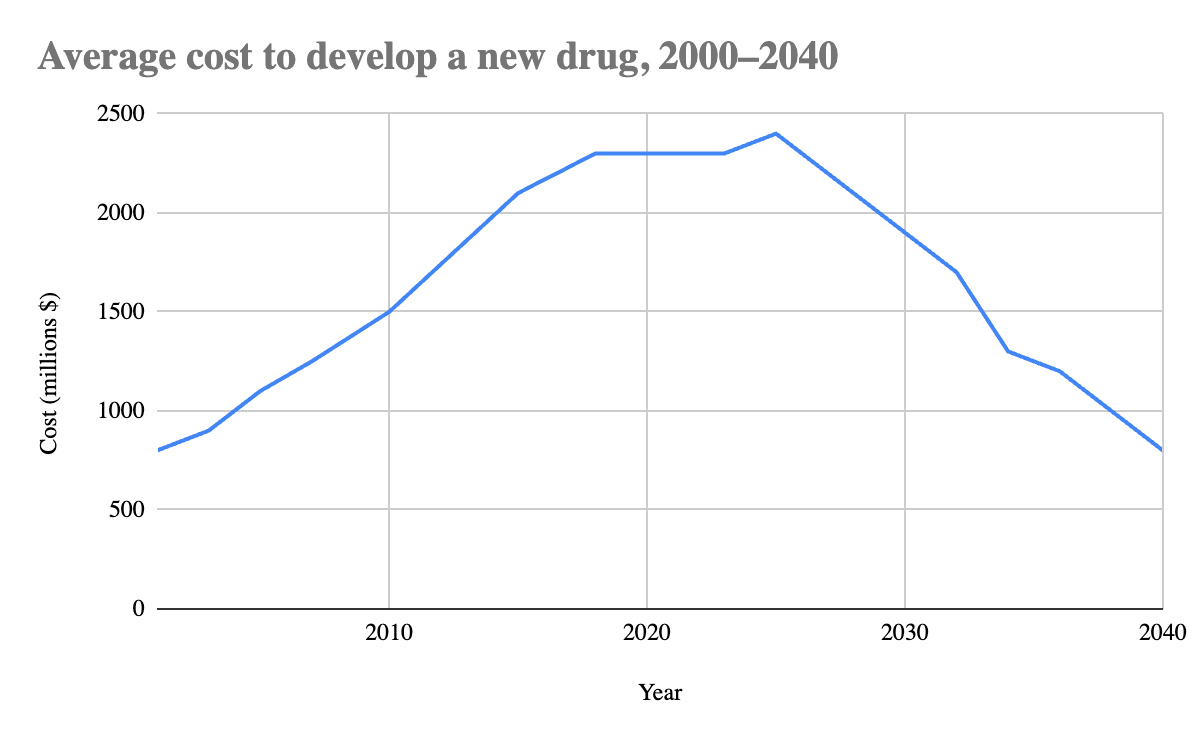
No - US biotech companies don’t aggressively pursue capital efficient drug discovery. The number of drugs approved per year stays flat over the next years and decade. The slow movement dovetails with continued, prohibitive US regulation that ultimately prevents fast human evidence. Companies stay focused on high-throughput screens which have limited predictive validity. The cultural stuffiness of US biotech means they aren’t aggressive experimental modes such as Phase 0 nor capital efficient trials in other countries. The biotech oldguard (biopharmas and old biotech funds) continue to profit disproportionately and biotech continues to be a largely slow and risk-averse industry. Biotech isn’t translated to larger, aesthetic and consumer markets. In short, US swiftly and decisively loses the battle for biotech dominance to China. Any serious drug makers that are in the US have to move to China to be part of the dominant biotech ecosystem.*
*This mirrors Fork #3 significantly.
Fork #5: There will be a collapse of incumbent drug distribution.
Context: Pharmaceuticals and health insurance are some of the most hated industries in the US, to levels on par with the oil and gas industry. This disdain has had led to a lack of brand loyalty at minimum and outright mistrust in the extreme. Skepticism about COVID mRNA vaccines in the US is one of the most illustrative examples. COVID mRNA vaccines are some of the most effective and safe vaccines in history, a legacy distorted into a strange flashpoint for otherwise health-conscious consumers. Research use only (ROU) peptides paint a similar picture. Today, millions of people are injecting themselves with largely unproven and potentially unsafe compounds. Reading between the lines, the millions taking ROU peptides show us what they think of the pharma industry - wanton injections of molecules we know little about, no controls, no shared learnings, and limited to no efficacy. The public’s perception isn’t accurate of course. We have good manufacturing practices (GMP) to ensure there’s not bacterial contamination (as there is with many ROU peptides), there are three series of trials which prove safety and then efficacy with hundreds to thousands of patients.
However, this confluence of outcomes begs the question, if public perception is so disjointed from the reality, the upshot is there’s an opportunity to make new company types that people trust and resonate with more. Put another way, will there be a collapse of incumbent drug distribution?
Yes - HIMS, Ro, 30Madison all show that millions of people would rather buy from a brand that feels more aligned with them than even generic drugs that cost less (that they get through their primary care physician). There are many reasons and consequences of this including better branding, meeting patients where they are (telehealth vs. in-person), and the feeling of self-control vs. paternalism they experience from their primary care doctors. The increasing number of therapeutics available through HIMS, Ro, and 30Madison also mean that they could gradually pull more and more primary care online. For any drug that has more demand than supply, compounded manufacturing under shortage conditions provides an on-ramp to the most coveted new therapeutics, legally.
It’s possible that the future of therapeutics is even more radical than HIMS, Ro, and 30Madison where, through the same portal people are able to get FDA approved drugs and ROU peptides and compounds. Ideally clinicians would be able to ensure safety of all products and be able to run studies on those currently in development. If the system routes to D2C cash-pay, health insurance gets pushed toward being the payer of last resort for catastrophic and chronic care rather than the gatekeeper of everyday therapeutics. Pharmacy Benefit Managers (PBMs) leverage over formularies erodes alongside health insurance furthering a transition to a CostPlus models of drug pricing and D2C models of drug distribution.
No - Serious, publicized harm from ROU peptides scares the public into understanding the risk of taking non-approved and unregulated therapies. At the same time, pharma and health insurance transition their brands to be more patient aligned and feel less extractive. Dave Ricks being the public face of Eli Lilly is the first of many CEOs addressing the public directly and showing they are likeable and well-intentioned people. Pharma going direct is paired with other goodwill building incentives such as the Generic Drugs Day and prevention of patent cliff extension for over 20 years (both ideas from the Great American Drug Deal). Public facing personas and goodwill building initiatives have to be paired with more drugs being approved per year to stop people with serious disease from trying to vibe code cures for their disease. For pharma and the current system to stay in control, there also needs to be more transparency in pricing between PBMs, health insurance companies, and patients. Claims denials by insurance companies need to also decrease while earlier, preventative care is covered more. While short-term losses will ensue, the increased health of the US population, increased patient agency and access to SOTA care will change public sentiment towards these industries to ensure lasting businesses both in health insurance and PBMs.
Fork #6: Biopharma becomes hyper-deflationary in mid-term (many assets for every target) and returns diminish drastically due to competitive pricing and higher distribution/marketing costs.
Context: I shared the questions in this doc on X. Many smart folks commented on their biggest questions in biotech. Matt Kirshner posed this question and it is something we’ve frequently discussed internally at Compound over the years. Specifically, we have stayed away from “consensus” indications because of the crowding that happens when a target for a large disease is validated. The reality of the matter is that there’s over 13,000 diseases with only ~1,500 of those having drugs specifically developed for them. So the question is how quickly will the pipelines be filled for the following 9,500 diseases and if this will mean hyper-deflation for assets in the mid-term (~5 years)?
Yes - In the next five years, prompt engineering, decentralized experimentation and fast human evidence will compound to address all of the 10,000 known diseases. Many new assets for every disease will commoditize discovery and new biology insights, putting the most pressure on clinical studies, recruitment and translation through the clinical trials. Since many new mechanisms can and will be investigated at once, each company pursuing one disease will have a warchest of mechanisms and targets it will pursue to first-in-human (FIH) studies. At each stage of the translation process insights from literature and related diseases will be explored and commercialized swiftly. One of the key differentiators of companies in the future will be ability to fundraise to pursue 50-100 different targets to FIH, significantly decreasing the clinical risk and increasing upside by having the largest search of mechanisms of adjacent diseases. Given the amount of likely shared mechanisms of new drugs and tangential diseases, off-label prescriptions will be more common in the future, especially with salesforces dedicated to label expansion.
No - Even though the timelines and scale of developing new molecules is significantly advanced in five years, the cost of translation is too high to cause hyper-deflation of most assets. Diseases with known mechanisms, high patient population spaces are already commoditizing in 2026 but to make excellent drugs for the remaining 9,500 disease will take more than 5 years given the timelines to translation, even with good FIH tailwinds. This provides significant opportunity now for startups addressing the long-tail of diseases, which are able with new data and insights to pursue new mechanisms. Increased competition around mechanistic disease understanding will lead to many preclinical and early clinical biotechs to *not* disclose their target until Phase II+. Not only this, but competition with China will lead to many companies not patenting until Phase II to keep their head starts for new mechanisms. This less-public nature of biotech will slow progress but protect value.
Fork #7: The asset-centric turn in biotech VC will produce a wave of orphaned, single-asset companies.
Context: When discussing the questions on X, Peter Crane asked this topical question. His framing was more sophisticated with: “The coming asset implosion in 12-18M as every board pushes their portfolios into “binary by stealth” asset-centric risk profiles, unpricing the financing risk to exit-able inflexion, in a market which is very constrained for assets outside core syndicates.” Specifically he’s curious whether the turning and singular risk of assets will lead to a dramatic collapse of biotechs in the next 12-18 months, especially outside of the Arch/Orbimed/Foresight syndicates. So will the single-asset “platforms” get financed to an inflection?
Yes - Misguided early-stage biotech investors over-rotated on assets to prove platforms. Hundreds of founders followed suit down preclinical and clinical pathways, only to find later stage investors aren’t convinced by their animal/FIH data. What’s worse is that most companies that developed assets showed that their platform didn’t work to increase preclinical/FIH therapeutic efficacy beyond standard of care. The over rotation on assets forced many companies into premature productization and didn’t give them enough time to find indications with true platform-disease fit. This hollowing of early stage biotech leads to a disillusionment of drug development outside of core biotech syndicates, further entrenching their success and power.
No - The wildly diverse modalities and mechanisms being pursued lead to an upswing of feasible and net new therapeutic science. Startups, though imperfect in their data packages, show core syndicates and broader industry the value of their new modalities and mechanisms in a language they understand. Not only this, but their capital efficiency of rapid in vivo evidence leads them to prove more with less, unseating the entrenchment of the core, historic biotech funds. While not all new modalities work, nor have the right platform- disease fit, many do work and are able to raise later stage capital. With science more learnable than ever and derisked with increased understanding of platform successes and failures, the investor group expands as the founders, modalities, and mechanisms pursued.
Predictions of the future
It wouldn’t be any fun to make the best bull and bear cases for the biggest questions in biotech and not pick a side. Afterall, at Compound, we love making falsifiable predictions because it helps with discourse and specificity of our own thinking internally.
Bio neolabs will become very large companies. There are early indications of this from Isomorphic’s $2.2bn raise from Thrive and others, and also potential for unlimited upside will prevent some of the best teams from selling early.
Next-generation CROs will become very large businesses indeed. There are multiple tailwinds including new buyers of biological data and in the next 5+ years a new group of people that can build and experiment with biology that don’t have formal training. The garage biotech vision hasn’t played out mainly because of the level of knowledge and long-tail of expensive instruments that take up space. CROs that increase legibility with good UI/UX and drop the cost per experiment are well-placed to benefit.
China will not become the global hub of biotech. Geopolitical tensions only increase as China is more aggressive in the South Pacific and the rest of the world over the next five years adapts our clinical trial and translation systems to look more like China’s.
There will be more drug approvals in the US per year. While there has been a plateau recently, we are up 20 new drug approvals per year on a 10-year basis. Given the quick translation of modalities into assets and interest in new targets and the human evidence tailwinds, there will likely be 10’s more drug approvals per year in 10 years time.
There will be a collapse of incumbent drug distribution. This is mainly driven by intense distrust that the general public has towards pharma and health insurance. It’s unclear what the new form mode of distribution will look like but we see it being a Hims-type company that has branding and messaging and prescription ease that’s more aligned with patients.
Biopharma does not become hyper-deflationary in the midterm. There are too many factors to optimize for to make, test, and translate excellent drugs in the next 5 years. This gives startups the ability to capitalize on technology tailwinds, shifts in cost and speed human evidence, and capture value from their asset translation.
The asset-centric turn creates many new drugs and validates assets as a translation path. There will be several high-profile failures in new platforms making assets. However, in aggregate the wave of new platforms bringing next-generation modalities and prosecuting new target space will lead new disease areas and therapeutic efficacy to be realised. The lowering bar for human evidence and decreased cost means that the number of drugs in clinical trials increases significantly.

We’d love to hear your thoughts on the future of biotech. We’ll keep publishing our list of questions, bear and bull cases, and our specific predictions. If you’re thinking of building here, please reach out to [email protected].