With frontier labs expanding into bio, biotech has become manic to sell to this emerging customer class. We are excited about this and predicted a handful of large bio companies could come from this thrust! However it’s value leaking and not dominant for most biotech companies to sell to frontier labs. Most of the excitement boils down to a new business motion in biotech. As an industry we are starved with two subpar business models outside of making therapeutics (which is also incredibly hard!). Outside of therapeutics, buyers are big pharmas on one end being notoriously difficult to sell to given cultural inertia and on the other end relationship driven BD or scientists, largely entrenched in their existing workflows and with little discretionary spending power.
Thus, having a new customer matters a lot. Especially a bio customer like the frontier labs which have more discretionary spend than most pharma companies, faster decision cycles, and have a use case where you can see quickly if your platform helps (eg. does your data improve evals?). Even in healthcare <> frontier lab sales, companies like Protege selling largely RWD have increased ACV from from five- and six-figure ACVs to mid-to-high seven figures in two years. There is an enormous opportunity here, but it might not be for everyone.

What are the labs using your data for?
Frontier labs buy data for two reasons right now. To (1) improve their core LLM or (2) to build novel products (like bio discovery engines or AI doctors).
For 1, we’re closely following the data and have generally seen that more diverse data for pretraining can improve downstream tasks (coding being the most famous example). However the logic learned from coding might not have the same uplift to LLMs as general protein binding data. In order to be a scaled seller to the labs, your startup’s bio data will need to be quickly and concretely shown to increase core LLM performance. There is a fair argument that if you stitch all biology companies’ data together, there will be general LLM uplift. I agree here. But the labs only allocate a small part of their overall budget to bio. The upshot is that the frontier labs likely won’t buy data from a majority of bio companies to elicit this core LLM uplift.
For 2, labs might be a great buyer if you buy into Claude Science and GPT-Rosalind going big. However, there’s a deeper question on how long will the labs care about bio? This is an existential point for companies that focus their entire force only on frontier and neolab sales. Right now, the frontier labs have to expand their own TAM to justify their hefty valuations. Building in bio+health verticals helps with that. And as many have pointed out before, bio+health products align the labs with humanity. It signals care and builds soft power.
However, the ugly truth is that it’s easier to spend billions on vanity projects when you’re a private company. As the frontier labs and neolabs go public, there will be increasingly more pressure to have spending discipline and focus on short-term gains vs. long-term visions. Even before going public frontier labs have pivoted from compute heavy projects not core to short term revenue will be the first to go. This was illustrated by OpenAI shuttering their video generation tool, Sora, earlier this year. Founders have to look critically at how core bio will be to the labs in 5-10 years and how much reorienting their business around a frontier lab matters for their big vision. Data sales may be a Siren call because frontier labs might not care for long enough for it to matter to startups and because it might destroy your main company.
Built to sell vs. selling data as a side business
Many companies today servicing the AI labs are purpose-built to sell data. Bio companies are mostly working towards a new therapeutic and trying to sell data as a side business. This is a large distinction in company operations and more importantly the startup’s raison d’être.
Going a layer deeper, Mercor/Scale are good at understanding and premeditating the frontier labs’ needs and being malleable in terms of the data types and formats the labs need along with in some cases the infrastructure. They relabel data to be more useful and get new data types by paying lawyers, writers, mathematicians, etc. Because of this success, we have seen a range of new companies that are basically attempting to be “Mercor for X” with X being a certain type of hard to gather or verify data type.
For most bio companies, it’s implausible to change between vastly different data types at the same rate. You have to buy new measurement instruments, you have to teach/learn/automate new workflows, and you might have to stop collecting the data type you care about in service of data for the labs. In other words, you can’t just interview/probe biology like Mercor does with PhDs.
Selling to labs is a hard decision for bio companies because most can’t quickly and easily change the underlying experiments they’re doing, unless they’re fully built to do that. Only a small subset of highly generalizable, deep predictive readout platforms are broad and valuable enough to be successful data sellers. Companies that successfully land and expand will purely be data sellers OR will have high overlap with their data they’re generating and the data the lab wants.
You don’t have to respond to the Siren Call
Many bio startups will sadly be lured by the Sirens of data sales to conform to what the frontier labs potentially want. We don’t want this to be you! The upshot is that most bio companies aren’t poised to sell to the frontier labs and frontier labs don’t have the budget to buy from everyone. While a new business model and buyers are appealing, founders have to dig deep to understand their platform <> frontier lab fit (PFF). Is their tech general enough to improve Rosalind and Claude Science evals or (even better!) general LLM performance? What is the investment they’d need to make to improve these evals? Is this investment on or off the optimal path to their big vision?
Every great company has to do slight detours to raise money, whether that’s demos, unscalable product builds, first customers that will likely churn. It’s great to have another proof point possible as a bio+health platform company too! In most cases though, being hooked on a revenue stream that’s not core to the ultimate vision and business you’re building is risky and should only be done in cases which enable more funding and/or data can be reused for the main thrust of the company.
We’d love to talk to builders about this dynamic and share what we’re seeing on the startup side. I’m at [email protected].
Thanks Michael Dempsey for trading thoughts and giving ideas for this piece. Also thanks to Eryney for a dinner that catalyzed a lot of these ideas!
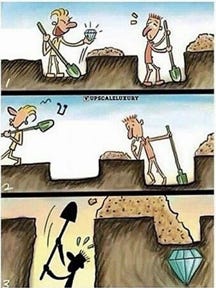
Comic from here.